

For years, major AI releases have followed a predictable formula.
A new model arrives. It performs better on benchmarks, writes stronger code and handles more difficult questions than the generation before it.
But the most important part of OpenAI’s latest release is not simply that the AI has become more capable. It is that OpenAI is beginning to organise intelligence differently.
GPT-5.6 is not one model trying to do everything.
It is a family of three engines:
- Sol, the flagship model for complex reasoning and professional work;
- Terra, designed to balance intelligence and cost;
- Luna, built for fast, affordable, high-volume workloads.
Instead of using the most powerful and expensive model for every request, businesses and applications can use different levels of intelligence for different kinds of work.
The result is less like one digital brain and more like a coordinated workforce.
GPT-5.6: Frontier intelligence that scales with your ambition | OpenAI
Sol, Terra and Luna in plain English
The easiest way to understand GPT-5.6 is to compare it with a well-run company.
Not every task needs to be handled by a senior strategist. Not every customer enquiry requires a specialist. And repetitive administrative work should not consume the organisation’s most expensive resources.
GPT-5.6 applies the same logic to AI.
| Engine | Best suited for | Think of it as |
|---|---|---|
| Sol | Complex reasoning, coding and high-value professional work | Senior strategist |
| Terra | Everyday analysis, creation and business operations | Skilled professional |
| Luna | Fast, repeatable tasks at large scale | High-speed operator |
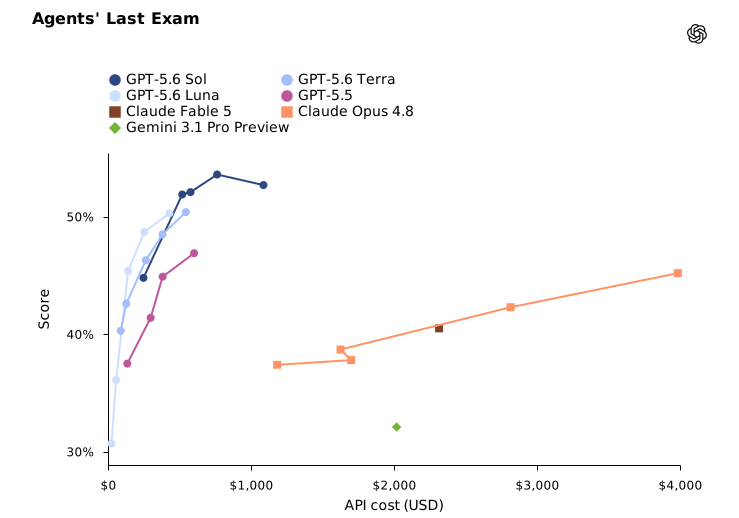
OpenAI describes Sol as its flagship model, Terra as the lower-cost option that balances capability and price, and Luna as the fastest and most affordable member of the family.
The point is not that one model is “good” and the others are weaker.
Each model is designed for a different position in the workflow.
Sol: when the problem is difficult and the answer matters
It is designed for complex reasoning, software engineering, scientific analysis, cybersecurity and professional tasks that may require several steps, tools and decisions.
You might use Sol to:
- inspect a large software system;
- investigate why a business process is failing;
- compare a substantial collection of documents;
- design a new product architecture;
- conduct technical or financial research;
- or manage a difficult task that develops over a long session.
These are not simple question-and-answer requests.
They require the system to understand the goal, plan the work, use tools, evaluate intermediate results and continue until it reaches a useful conclusion.
OpenAI presents Sol as the default starting point when maximum capability is more important than minimum cost. The standard gpt-5.6 API alias also routes to Sol.
In human terms, Sol is the person you involve when the problem is ambiguous, consequential or genuinely hard.
Terra: the model most businesses may use every day
Most business tasks do not require the most powerful model available. They require reliable intelligence at a cost that makes repeated use practical.
That is the role Terra is designed to fill.
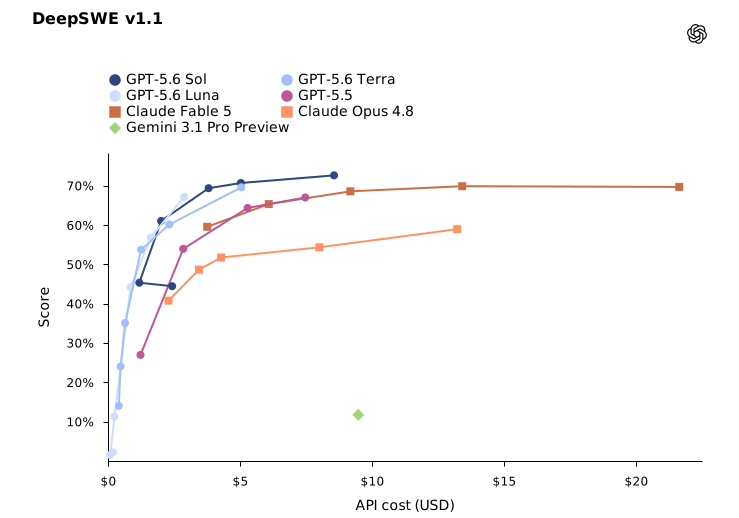
OpenAI positions it as a lower-cost model with performance competitive with GPT-5.5, intended to balance intelligence and cost.
Possible uses include:
- preparing reports;
- analysing customer feedback;
- researching competitors;
- reviewing business documents;
- generating marketing material;
- building routine software features;
- assisting customer-service teams;
- and turning unstructured information into clear recommendations.
Terra is not merely a lightweight assistant for basic text generation.
It is positioned as a capable professional model that can perform substantial work without the cost profile of the flagship tier.
For many companies, that balance matters more than achieving the highest possible benchmark score.
A model only creates business value when it can be used repeatedly, consistently and economically.
Luna: speed and scale
That includes the enormous number of small tasks running behind modern applications:
- classifying emails;
- extracting details from forms;
- organising CRM records;
- summarising short documents;
- translating content;
- qualifying sales leads;
- generating metadata;
- routing support requests;
- and converting unstructured text into structured data.
OpenAI describes Luna as its fastest and most affordable GPT-5.6 model, intended for cost-sensitive, high-volume workloads.
Its value becomes obvious when AI is used thousands or millions of times.
A recruitment company, for example, may not need Sol to inspect every incoming application.
Luna could extract the candidate’s experience, language level, availability and location. Terra could evaluate the strongest candidates. Sol could be reserved for unusual or high-value cases.
That creates a practical hierarchy:
Luna processes. Terra analyses. Sol resolves.
This is one of the most important ideas behind the release.
AI systems no longer need to spend maximum intelligence on every task.
They can allocate it.
The real innovation is orchestration
The three-model structure reflects a broader change in how AI systems are being built. Until recently, most users interacted with AI as a single assistant.
You gave it a prompt. It produced an answer. You corrected it, added more detail and asked it to try again.
The emerging model is different. You provide an outcome.
The system interprets the objective, chooses tools, completes several stages of work and adapts as the task develops.
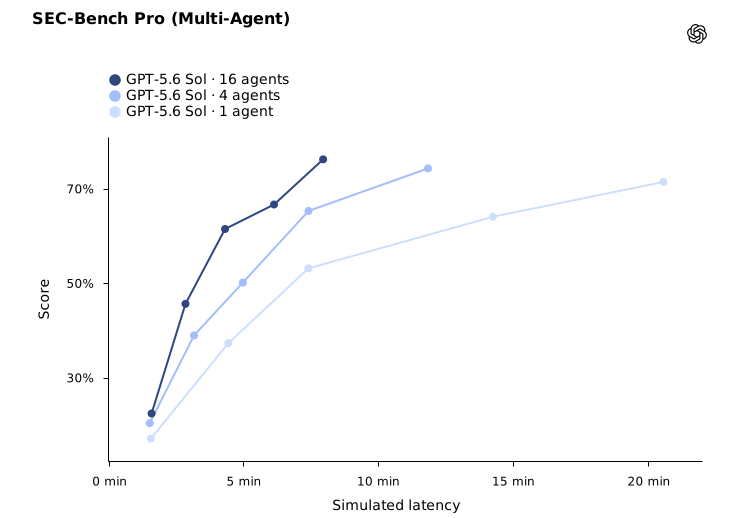
OpenAI says GPT-5.6 is designed to navigate ambiguity, adjust as work unfolds and produce polished outputs with less prompting.
That is a meaningful shift. The user no longer has to specify every step in advance. Instead, the AI is expected to understand more of the operational structure itself.
For example, rather than writing:
First review our sales data, then group the results, calculate conversion rates, identify weak stages, compare monthly performance and prepare five slides.
A user could say:
Analyse where our sales pipeline is losing the most revenue and prepare a short presentation with the highest-impact improvements.
The second request describes the desired result, not the full procedure.
A more capable system must decide what information matters, how to analyse it and how to communicate the conclusion.
The interaction becomes less like programming a machine and more like briefing a competent colleague.
From answering questions to completing work
The practical value of AI does not come from producing impressive paragraphs.
It comes from reducing the number of unfinished steps left for the user.
A model that suggests how to structure a report is useful.
A model that researches the subject, analyses the material, writes the report, produces the charts and delivers a polished document is substantially more valuable.
OpenAI says GPT-5.6 improves work across software, research, documents, spreadsheets and visual outputs, with stronger performance in areas such as layout, visual hierarchy and design judgement.
This is where the distinction between a chatbot and an operational system becomes important. A chatbot provides information.
An operational system helps finish the task. That does not mean the output should be accepted without review. It means the AI can carry more of the process before human judgement is required.
Efficiency is becoming part of intelligence
AI performance is often discussed as if the only goal were maximum capability. In production systems, that is not enough. A model must also be fast enough, affordable enough and consistent enough to justify being used repeatedly.
OpenAI highlights efficiency as a central part of GPT-5.6. The company reports improvements in token use, latency and the economics of long-running agentic workflows. For a casual user, token efficiency may seem irrelevant. For a company processing large volumes of work, it can determine whether an AI system remains a prototype or becomes a viable product. This is why Terra and Luna matter.
The strongest model may attract the most attention, but scalable AI depends on using the appropriate amount of intelligence for each task.
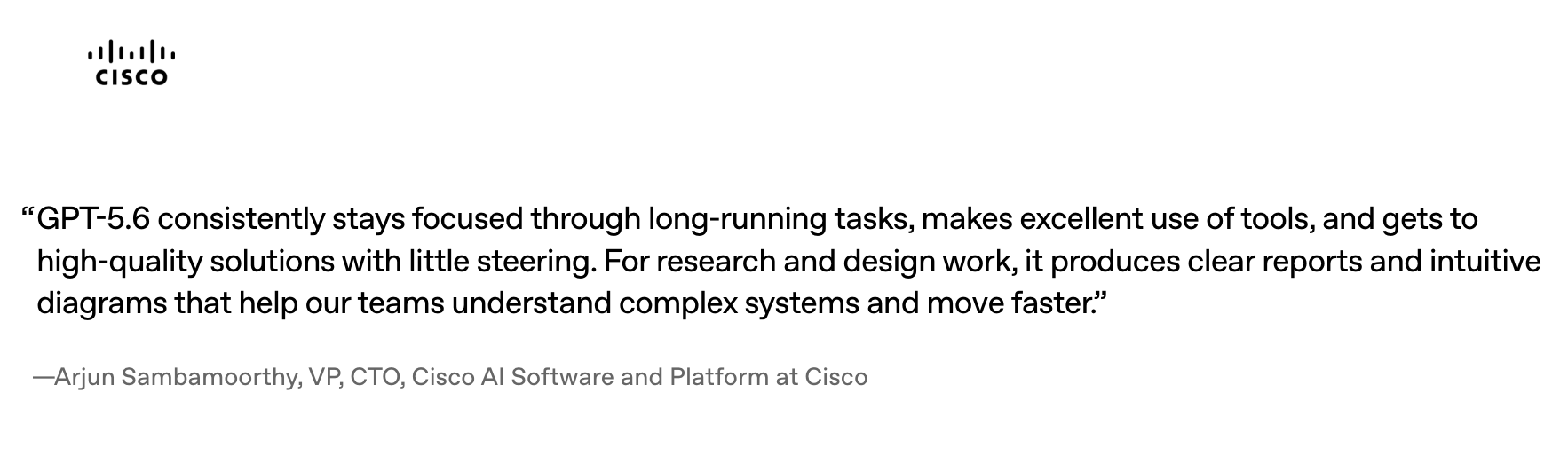
“GPT‑5.6 consistently stays focused through long-running tasks, makes excellent use of tools, and gets to high-quality solutions with little steering. For research and design work, it produces clear reports and intuitive diagrams that help our teams understand complex systems and move faster.”
More autonomy also creates more responsibility
Systems that can complete longer and more complex tasks can also make larger mistakes. An incorrect sentence in a draft is inconvenient. An incorrect action taken automatically across thousands of records can be expensive.
The more responsibility AI receives, the more important oversight becomes. OpenAI says the GPT-5.6 family was released with its most robust set of safeguards to date, including protections designed for stronger capabilities in cybersecurity and other higher-risk domains. But safeguards do not remove the need for good system design.
Businesses still need:
- clear permissions;
- reliable source data;
- audit trails;
- escalation rules;
- and human approval for consequential actions.
Smarter orchestration can automate good processes. It can also automate bad ones faster. The quality of the workflow remains as important as the intelligence of the model.


Discussion