Optimizing AI Prompts for Business Automation Strategies
0:00
/982.224
Podcast generated by Google NotebookLM
Introduction: From Basic Prompt to Advanced AI Strategy
At iFlow.bot, we don’t settle for generic, one-line AI prompts. We believe in pushing AI reasoning to the next level, ensuring that our prompts generate deep, actionable insights rather than surface-level answers.
This case study showcases how we transformed a basic AI automation prompt into a fully optimized business strategy using advanced prompting techniques, including:
First Principles Thinking
Multi-Agent Debate Simulation
Systems Thinking for Cross-Integration
AI Self-Reflection & Recursive Improvement
By applying these techniques, we created an AI-powered strategy that automates 80% of business operations while enhancing human creativity.
Step 1: The Original Prompt (Basic Level)
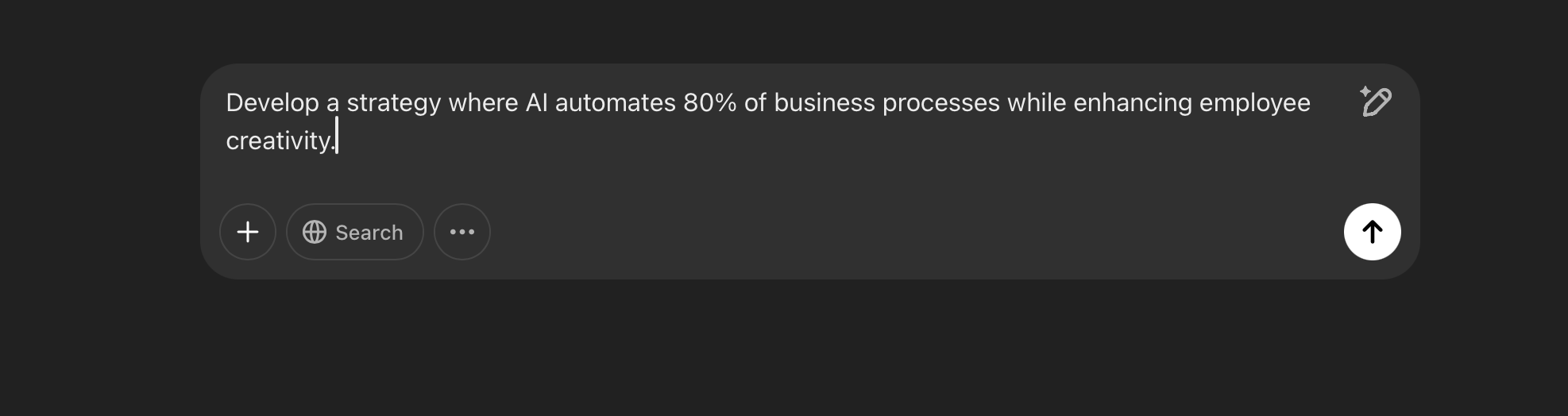
"Develop a strategy where AI automates 80% of business processes while enhancing employee creativity."
Original Prompt
🔴
Problem: This prompt is too broad and doesn’t force AI to engage in deeper reasoning. A generic AI response might provide obvious answers without addressing real challenges, financial considerations, or industry-specific strategies.
✅
Goal: Refine the prompt using advanced methodologies to ensure AI generates a high-value, structured response with strategic depth
Step 2: Level 5 Prompt Optimization
Optimized Prompt:
You are a world-class business transformation strategist specializing in AI-driven operational efficiency and human-AI collaboration. Your task is to develop a groundbreaking strategy where AI automates 80% of business processes while enhancing employee creativity.
**Step 1: Break it Down Using First Principles Thinking** Identify the fundamental components of business operations that must be automated to maximize efficiency. Rebuild the strategy from the ground up, ensuring no assumptions limit innovation.
**Step 2: Multi-Agent Debate Simulation** Present three opposing viewpoints:
1. A CEO who wants to automate everything for cost efficiency.
2. An employee who fears job displacement due to AI.
3. An AI ethics expert concerned with over-automation risks.
Have these three perspectives debate the pros and cons of full AI automation. Extract key insights from their arguments to refine your strategy.
**Step 3: Systems Thinking – Integration Across Business Domains** Design an AI-powered business model where automation enhances, rather than replaces, human input. Ensure seamless integration across HR, marketing, operations, and customer service.
**Step 4️: AI Self-Reflection – Critique & Optimize the Strategy** Now, evaluate your AI-generated strategy. Identify its weaknesses and blind spots. How can the plan be further optimized for efficiency while maintaining human value? Refine the response to mitigate risks and maximize business impact.
**Final Output:** A deeply structured, multi-layered strategy that balances AI-driven automation and human creativity for sustainable business growth.
0:00
/0:08
Optimized Prompt
Why This Works:
Forces AI to go beyond surface-level automation answers.
Simulates real-world business conflicts for a more nuanced approach.
Ensures the final AI-generated strategy is detailed, actionable, and adaptive.
Step 3: AI’s Initial Response (Before Refinement)
Strengths:
✔ Categorizing tasks for automation vs. human-led work ✔ Analyzing automation impact on different business domains
Weaknesses:
❌ Lacked real-world case studies & financial ROI considerations ❌ No structured roadmap for phased AI adoption
Conclusion: The AI’s response was insightful but incomplete, so we forced AI to critique its own work and refine it further.
The AI generated a structured strategy, but had key weaknesses, including: ✔ Categorizing tasks for automation vs. human-led work ✔ Analyzing automation impact on different business domains ✔ Identified missing real-world case studies & financial ROI considerations ✔ Recognized the need for a structured roadmap for phased AI adoption
Conclusion: The AI’s response was insightful but incomplete, so we forced AI to critique its own work and refine it further.
Step 4: AI Self-Reflection & Recursive Improvement
By prompting AI to analyze its own flaws, we uncovered:
Most AI stories are noise. This one is different. Here’s the grounded version of how ChatGPT, DNA sequencing, AlphaFold, and scientific collaboration helped shape an experimental cancer treatment for one dog in Australia.
If you’re tired of overpriced AI assistants and unstable agents, this is your roadmap. Learn how to build a stable, low-cost vibe coding stack using Kilo Code inside VS Code — from model selection to configuration that actually performs.
How to write Suno v5 prompts that work? Learn how to craft style and lyrics prompts that unlock genre, mood, instrumentation, and vocals. Includes examples, FAQs and practical tips for unique songs.
Every missed field, free-typed category, and duplicate name makes your AI dumber. Whether you’re wiring up a chatbot for customer FAQs, plugging into AI marketing automation, or testing workflow automation tools, the biggest unlock is not another app it’s a clean, structured database you control.
Here’s a
Learn how to write Sora 2 prompts that look cinematic and cut together cleanly. API settings, shot structure, lighting, dialogue, image references, Remix workflow, and ready-to-use templates.
Is your business drowning in fragmented data? Discover the "Golden Record" – a definitive, unified view of your customers that cleans up chaos, makes analytics reliable, and prepares your systems for the age of AI. Learn our simple 5-step process now.